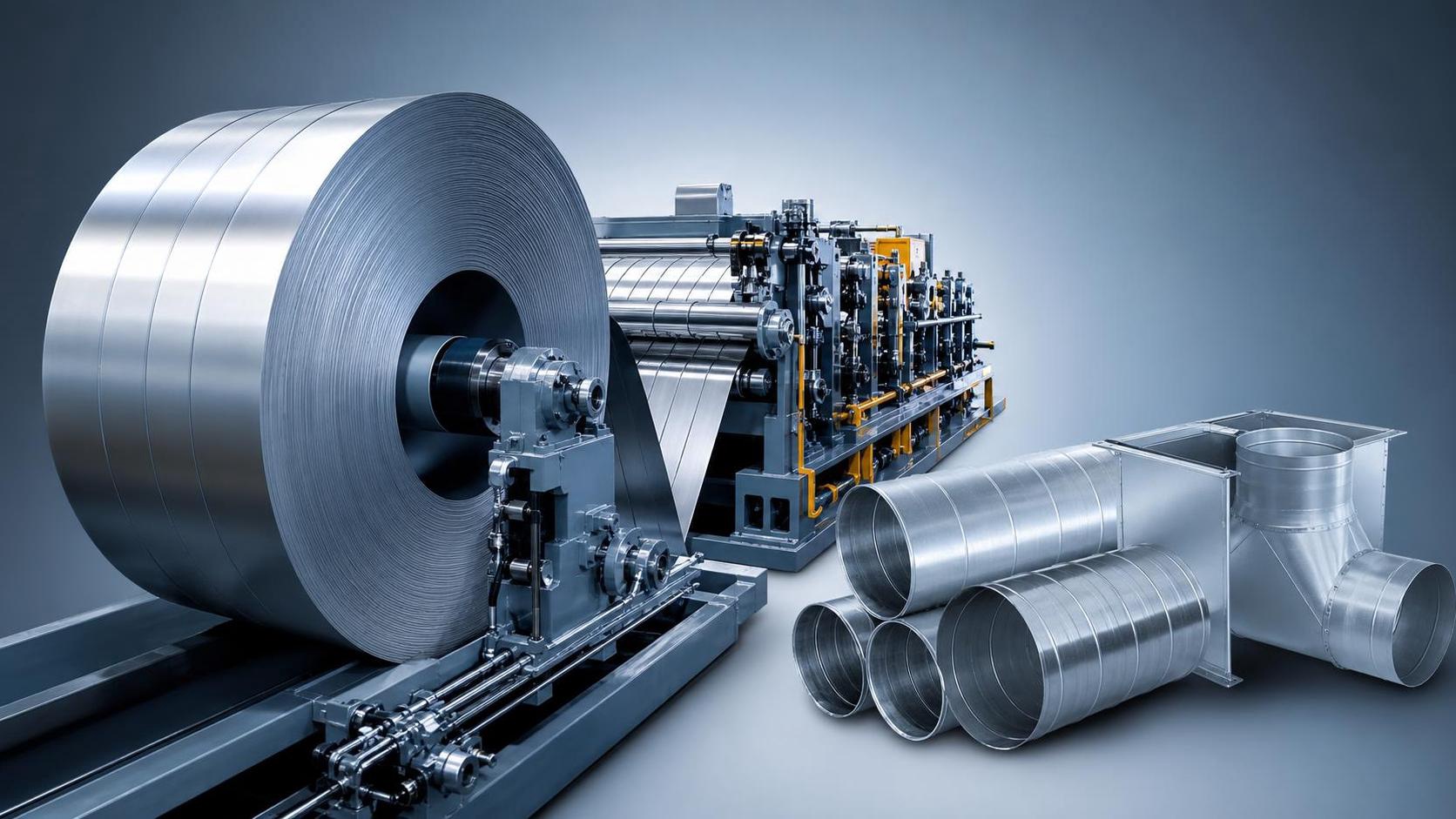
What Spiral Coils Really Mean in Steel Processing
In steel trade and fabrication, the term “Spiral Coils” can cause confusion because it is used a little differently depending on who is speaking. A buyer may use it to describe steel strip or sheet wound into a coil form. A manufacturer may be referring to coil-fed material that will later be slit, roll formed, stamped, or shaped into spiral products such as ducts, tubing, or wound structural components. In some construction conversations, the phrase is also loosely associated with coiled steel used to produce spiral welded pipe. That is why the first useful step is not to ask only what a spiral coil is, but what role the coil is playing in the process chain.
At its core, a coil is steel that has been rolled into a continuous length and wound for storage, transport, and downstream processing. The “spiral” idea usually points to the geometry of winding or to the later forming method, not to a separate metallurgical category. That distinction matters. Spiral Coils are not automatically a unique grade of steel, a special finish, or a standalone international product standard. In practice, the value comes from how coiled steel lets processors handle large volumes efficiently and feed material continuously into production lines.
This is one reason coils are so common in the steel sector. Flat steel produced at the mill is far easier to move and convert in coil form than as many separate sheets or plates. Once the material reaches a service center or fabrication plant, it can be uncoiled, leveled, slit into narrower strips, cut to length, or formed into profiles. When people speak about Spiral Coils in this wider industrial sense, they are often talking about steel as an input material rather than a finished end product.
Why Coil Form Matters More Than It Sounds
Coil form changes the economics and the engineering of steel processing. A continuous coil allows longer production runs, fewer interruptions, and more consistent feeding into automated equipment. That is especially relevant where dimensional repeatability affects later forming, welding, or assembly. In roll forming lines, duct manufacturing, tube mills, and certain structural component operations, stable coil quality is often more important than the casual description used in a sales inquiry.
Several properties determine whether a coil is suitable for a given job: steel grade, thickness range, width, yield strength, surface condition, edge quality, and internal diameter for line compatibility. None of these can be inferred from the phrase “Spiral Coils” alone. Two coils may look similar in storage, yet behave very differently in forming. One may be intended for cold forming with tight dimensional tolerance, while another is better suited to structural applications where strength is the primary concern and surface appearance is secondary.
That is also where misunderstanding begins. Some buyers assume the coil shape itself guarantees flexibility or ease of processing. It does not. If the chemistry, hardness, or coating system does not match the downstream method, the material can crack during forming, spring back beyond tolerance, or create welding issues later. Experienced processors usually evaluate the conversion route first and then match the coil specification to that route.
Where Spiral Coils Show Up in Real Applications
In steel processing, coiled material is the starting point for a large share of manufactured products. One common use is slitting. A wide master coil is slit into narrower strips, and those strips become feedstock for tubes, channels, framing members, cable trays, reinforcement accessories, and many light-to-medium gauge fabricated parts. If the downstream product is produced in a helical or spiral forming process, the source material may informally be called a spiral coil even though the original product delivered from the mill was simply flat rolled steel in coil form.
Another important application is spiral welded pipe production. In that process, steel strip or plate is formed helically and welded along the seam to create large-diameter pipe. Here the relationship between coil material and final product is direct. The coil is not the pipe, but the consistency of the feed material has a strong effect on weldability, dimensional control, and production stability. This is especially relevant in sectors such as water transmission, piling, certain infrastructure works, and industrial fluid transport, where spiral welded pipe is selected for manufacturing efficiency or size range considerations.
Construction uses are broader than many people expect. Coiled steel may end up in roofing systems, cladding supports, lightweight structural framing, decking accessories, HVAC duct components, spiral ducts, and prefabricated building elements. In these applications, the material’s journey matters more than the label. A contractor may never buy “Spiral Coils” directly, but many installed components on site begin life as coil-fed steel processed through forming lines.
Manufacturing beyond construction also relies heavily on this format. Appliance casings, storage systems, enclosures, agricultural equipment parts, and general industrial components often come from cold rolled, hot rolled, galvanized, or pre-painted coils. The industry language shifts with the market segment, but the logic stays the same: coil form supports throughput, consistency, and material yield.
Not Every Coil Is Interchangeable
One of the most useful ways to understand Spiral Coils is to stop treating them as a single product family. In procurement and engineering practice, the real questions are narrower.
- Is the material hot rolled, cold rolled, galvanized, stainless, or coated?
- Will it be formed, welded, bent, perforated, or exposed to weather?
- Does the job require appearance quality, corrosion resistance, structural performance, or a combination?
- Will the coil run through a high-speed automated line or a lower-volume fabrication setup?
These questions influence the actual specification. For example, galvanized coil may be preferred where corrosion protection is needed for ductwork or building envelope accessories. Hot rolled coil may be sufficient for certain structural or industrial parts where surface finish is less critical. Cold rolled coil may be chosen when tighter dimensional control and better surface quality are needed. Stainless coil enters the picture where corrosion resistance or hygiene requirements are higher, such as in food, chemical, or certain architectural environments.
Standards also vary by product and market. Structural steel, line pipe feedstock, coated sheet, and stainless strip are not governed by one universal rule set. A serious buyer checks the applicable standard for the specific material category and final use instead of assuming the term “Spiral Coils” covers compliance. That is particularly important when the downstream product must meet construction codes, pressure-related requirements, or corrosion-performance expectations.
How Processors Judge Suitability
In real factory conditions, suitability is judged less by broad description and more by process behavior. Does the coil unroll cleanly? Is the flatness acceptable after leveling? Are the edges suitable for slitting or welding? Does the material maintain tolerances after forming? These are practical checkpoints, and they often reveal more than generic catalog wording.
For spiral welded products, weld consistency and strip geometry are especially important. For roll formed construction parts, springback, coating integrity, and profile stability matter. For spiral duct and HVAC applications, fabrication efficiency and joint quality become relevant. The same coil width or thickness does not guarantee identical production results if mechanical properties vary from one batch to another.
This is why experienced suppliers usually ask for the end use early in the conversation. They are not only trying to sell a grade. They are trying to avoid mismatch between the steel and the process. A coil that is technically available can still be the wrong industrial choice if it increases scrap, slows the line, or creates avoidable finishing problems.
Common Misunderstandings Around Spiral Coils
A frequent misunderstanding is that Spiral Coils are always a finished product. In many cases they are not. They are semi-finished input material waiting to be transformed. Another is that the word “spiral” automatically refers to spiral welded pipe. Sometimes it does; sometimes it simply reflects the wound storage form of steel strip or the way the material will later be shaped.
There is also a tendency to compare coils and sheets as if one were always better. The choice is usually operational. Coils make sense when a processor needs continuous feed, production efficiency, and flexible conversion into multiple dimensions. Sheets make sense when lower volume, easier handling, or direct fabrication is more practical. The better format depends on the manufacturing route, handling equipment, and waste profile.
Another weak assumption is that all construction-grade coil applications are low precision. Many are not. Profiled components, façade support parts, and tube or duct inputs can demand stable mechanical properties and tight process control. Treating coil-fed products as simple commodity items often leads to quality disputes later.
A Better Way to Read the Term
If you encounter the term in a document, quote, or technical discussion, read it in context. Ask whether it refers to the supplied material form, the downstream forming method, or the final product category. Then look at the actual specification details: grade, thickness, width, coating, tolerance, and intended process. That approach gives a clearer picture than relying on the phrase itself.
In steel processing and construction, Spiral Coils are best understood as part of a workflow. They sit between mill production and fabricated application. Their importance comes from convertibility, not from a mysterious standalone identity. Once that is clear, the practical questions become easier: what is the steel, how will it be processed, what standards apply, and what performance is expected after forming? Those are the questions that actually determine whether a coil is suitable for the job.
Can't find what you're looking for ?
Leave a Message we will call you back quickly!
Product Classification