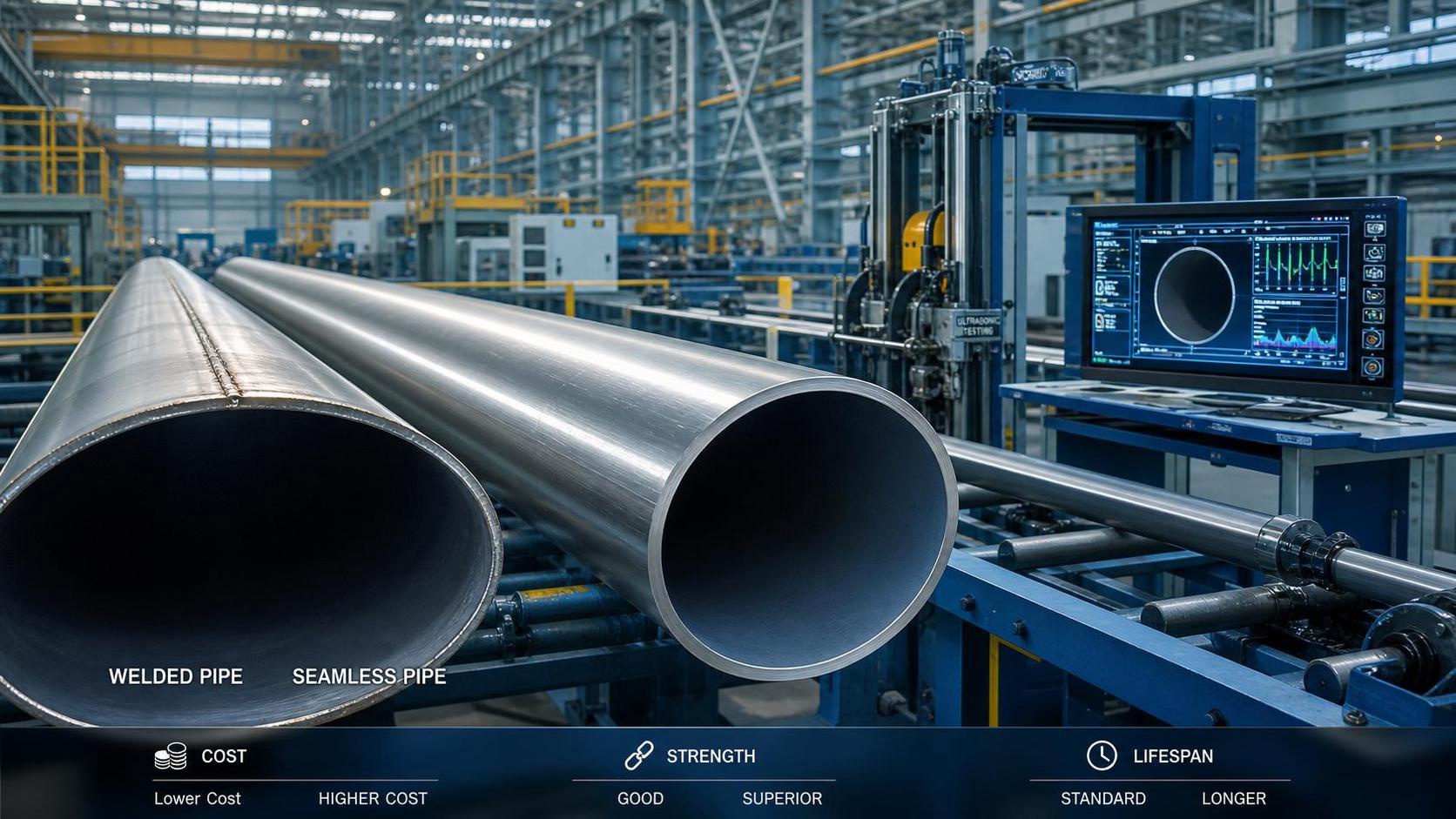
How to Compare Welded and Seamless Gas Pipe for Cost, Strength, and Service Life
Choosing the right gas pipe affects project budget, operating safety, and long-term maintenance costs.
For purchasing decisions, the comparison goes far beyond unit price.
A suitable gas pipe must match pressure class, service environment, fabrication method, and expected life cycle.
This guide explains how welded and seamless gas pipe differ in cost, strength, and service life, so the final choice is practical and defensible.
Why This Comparison Matters
In many projects, gas pipe is not a simple commodity item.
It directly affects installation efficiency, inspection scope, shutdown risk, and replacement timing.
That is why welded versus seamless gas pipe often becomes a procurement checkpoint.
The lower upfront price may not deliver the lowest total ownership cost.
At the same time, the highest specification is not always the smartest buy.
What Welded and Seamless Gas Pipe Mean
Welded gas pipe is produced by forming steel strip or plate into a tube and joining the seam.
Common processes include ERW and other longitudinal welding methods.
Seamless gas pipe starts from a solid billet.
The billet is pierced and rolled into a hollow tube without a welded seam.
This production difference drives most performance and pricing gaps.
Cost Comparison: Initial Price and Total Project Spend
From a pure purchase-price view, welded gas pipe is usually cheaper.
Its raw material utilization is efficient, and production speed is generally higher.
Seamless gas pipe usually carries a higher price because the process is more material- and energy-intensive.
However, price per meter is only one part of the decision.
In actual sourcing, the more useful question is total installed and operating cost.
- Welded gas pipe often reduces material budget in low- to medium-pressure systems.
- Seamless gas pipe may reduce failure risk in high-pressure or high-temperature service.
- Inspection costs can differ depending on code requirements and weld quality controls.
- Lead time can shift total cost when shutdown schedules are tight.
A cheaper gas pipe becomes expensive if it triggers extra testing, rejects, or short replacement cycles.
So the right comparison should include procurement, fabrication, inspection, downtime, and maintenance.
Quick Cost View
Strength and Pressure Performance
Strength is one of the first reasons buyers consider seamless gas pipe.
Because it has no longitudinal seam, it is often preferred for demanding pressure service.
This does not mean welded gas pipe is weak.
Modern welded pipe can perform very well when manufacturing quality, standard compliance, and testing are well controlled.
Still, the welded seam remains the main area for scrutiny.
In pressure cycling, vibration, or severe temperature swings, that difference matters more.
For high-pressure gas pipe systems, seamless options often provide more design confidence.
When Strength Becomes a Deciding Factor
- High operating pressure
- Frequent pressure fluctuations
- Critical shutdown consequences
- Harsh mechanical stress during service
- Strict code or client specification requirements
If several of these conditions apply, seamless gas pipe usually deserves serious consideration.
Service Life: What Really Drives Longevity
Service life is not decided by manufacturing method alone.
It depends on corrosion exposure, pressure load, installation quality, wall thickness, coating, and maintenance discipline.
That said, seamless gas pipe often has an advantage in severe service because there is no seam-related weak point.
Welded gas pipe can still deliver long service life in controlled environments and properly rated applications.
A common mistake is assuming all gas pipe failures come from pressure.
In reality, corrosion and poor installation often shorten life faster than design stress.
This also means the right specification can outperform a higher-cost option used carelessly.
Key Life-Cycle Checks
- Confirm actual gas composition and moisture level.
- Review internal and external corrosion risks.
- Check pressure peaks, not only normal operating pressure.
- Verify coating, lining, or galvanizing requirements.
- Match pipe standard to the project code and inspection plan.
Corrosion Resistance and Maintenance Considerations
Neither welded nor seamless gas pipe is automatically corrosion-proof.
Material grade, coating system, humidity, soil condition, and condensate behavior are more influential.
However, the weld area in welded gas pipe may need closer quality review, especially in corrosive environments.
Maintenance teams usually prefer predictable inspection points and clear traceability.
This is where mill certification, NDT records, heat numbers, and coating data become valuable.
Good documentation supports both warranty control and future replacement planning.
Application Scenarios: Which Gas Pipe Fits Better
Welded gas pipe is often a strong fit for general distribution lines and moderate operating conditions.
It is also attractive when project cost control is tight and approved standards are clearly defined.
Seamless gas pipe is more commonly selected for critical process lines, higher pressure, and more severe duty cycles.
The practical decision usually comes down to risk tolerance.
If a line failure creates major safety, production, or legal consequences, seamless gas pipe often becomes easier to justify.
A Practical Procurement Checklist
A workable gas pipe decision should be based on data, not assumption.
Before placing an order, review these points carefully.
- Required standard, grade, size, and wall thickness
- Operating pressure, test pressure, and temperature range
- Gas medium characteristics and corrosion exposure
- Required NDT, hydrotest, and certification documents
- Expected service life and maintenance interval
- Supplier traceability, production consistency, and delivery reliability
This checklist helps compare gas pipe offers on substance instead of headline pricing alone.
Final Decision: How to Choose with Confidence
If the priority is lower upfront cost in standard service, welded gas pipe is often the sensible option.
If the project demands higher pressure capacity, stronger reliability margins, and longer severe-duty performance, seamless gas pipe is usually worth the premium.
The best gas pipe is not the cheapest or the heaviest.
It is the one that fits the real operating risk, inspection requirement, and life-cycle budget.
In practical terms, compare both options against project conditions line by line.
That approach leads to a gas pipe decision that is cost-effective, technically sound, and easier to defend over time.
Can't find what you're looking for ?
Leave a Message we will call you back quickly!
Product Classification