Choosing a gas pipe material is rarely a simple matter of cost or availability. In residential and industrial systems, the pipe has to carry fuel safely, resist its environment, meet code, and remain reliable through years of pressure cycles, temperature changes, and maintenance work.
That is why material selection sits at the center of system performance. A gas pipe that works well inside a dry utility room may fail early in buried service, corrosive plant areas, or high-demand process lines. The right comparison starts with service conditions, then moves to metallurgy, joining method, compliance, and lifecycle risk.
Why gas pipe material choice matters more now
Gas distribution systems are under closer scrutiny than before. Safety expectations are higher, operating environments are more varied, and asset owners are less willing to accept premature replacement caused by avoidable material mismatch.
In the steel and section industry, this has pushed attention toward mechanical strength, coating quality, wall consistency, and traceable compliance. Material selection is no longer only a procurement issue. It is part of risk control and long-term asset planning.
Residential systems usually emphasize installation practicality, code acceptance, and corrosion resistance in moderate pressure conditions. Industrial systems often add vibration, wider temperature swings, chemical exposure, and tighter reliability targets.
The main gas pipe materials in real use
Several materials are commonly considered for a gas pipe network. They do not compete on a single performance scale. Each one fits a different combination of pressure, location, joining practice, and environmental exposure.
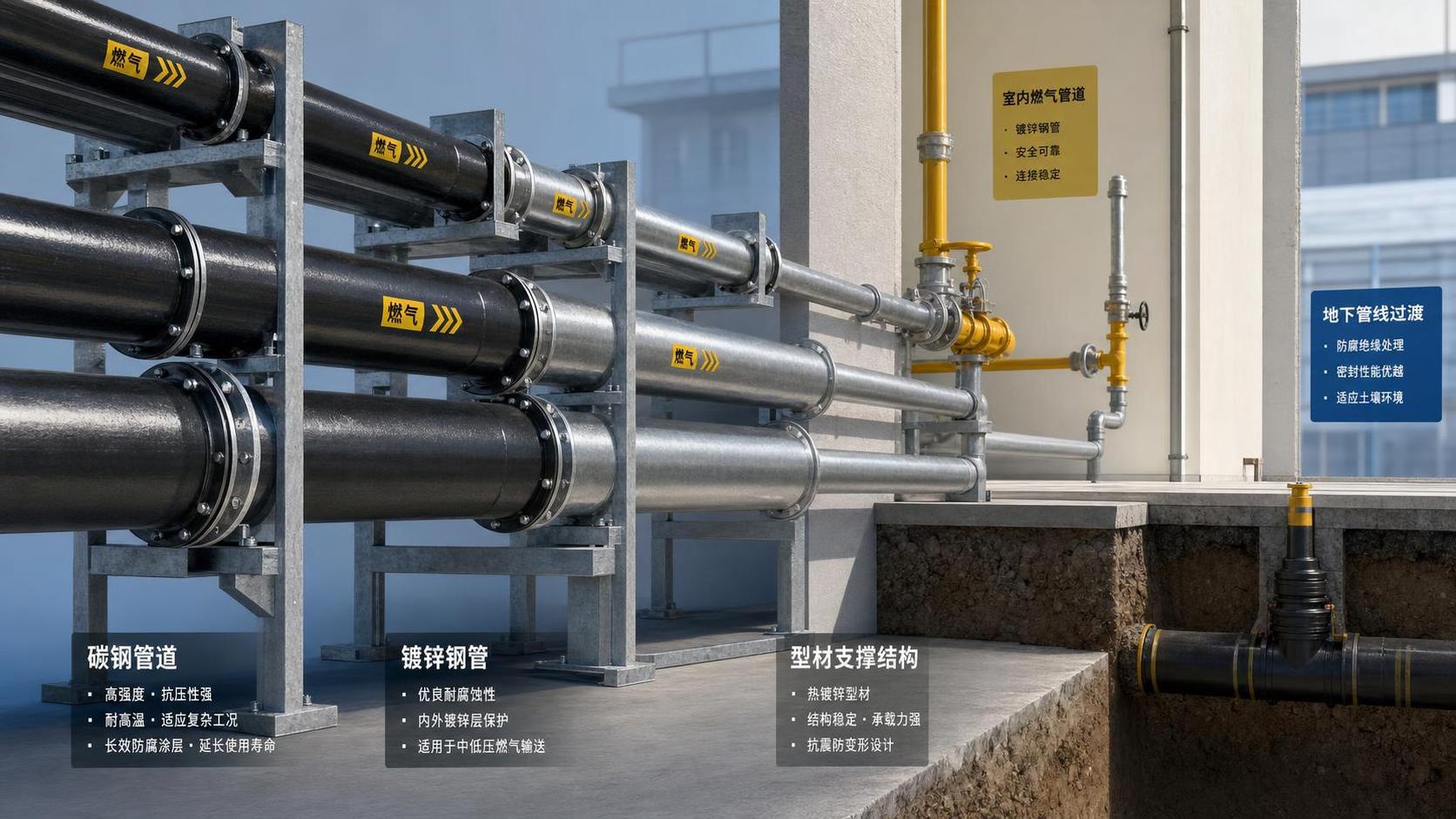
Carbon steel pipe
Carbon steel remains a standard choice for many industrial gas pipe systems and for some building services. Its main strengths are mechanical robustness, broad size availability, and familiarity across fabrication and inspection workflows.
It performs well where higher pressure, impact resistance, or elevated mechanical demand matter. Black steel pipe is common for natural gas distribution indoors, especially when local codes and installer capability support threaded or welded assembly.
Its limitation is corrosion. Unprotected steel in humid, buried, or chemically active areas can degrade quickly. In those cases, coating systems, wrapping, cathodic protection, or material substitution become necessary.
Galvanized steel pipe
Galvanized steel adds a zinc layer for corrosion protection. In some markets, it has been used for gas pipe applications where moderate environmental resistance is needed. However, its suitability depends heavily on local standards and service chemistry.
The protective layer can extend service life in certain conditions, but concerns about coating behavior, joint preparation, and long-term internal effects mean it is not universally preferred for fuel gas lines.
Copper tube
Copper is lightweight, easy to route, and familiar in building services. It has been used in some residential gas pipe installations, particularly where code permits and gas composition is compatible with copper service.
The concern is not only strength. Certain gas compositions can interact unfavorably with copper or copper alloys. That makes local fuel characteristics and code acceptance essential before specifying it.
Corrugated stainless steel tubing
Corrugated stainless steel tubing, often used in buildings, offers installation speed and routing flexibility. For indoor residential gas pipe layouts with many directional changes, it can reduce labor and fitting count.
Its use demands attention to manufacturer instructions, bonding requirements, mechanical protection, and code-specific installation rules. Flexibility is useful, but it does not remove the need for disciplined installation control.
Polyethylene pipe
Polyethylene is widely used for underground gas pipe distribution, especially in external service lines. It resists soil corrosion well and offers practical handling for buried installations.
Its use is generally limited to specific pressure classes, temperatures, and outdoor or buried applications. It is not a universal replacement for steel. Transition fittings and burial conditions must be evaluated carefully.
A practical comparison of common options
A side-by-side view helps narrow the field before detailed design review. The table below reflects common selection logic rather than a substitute for local code or product data.
What should drive the decision
The best gas pipe material is usually the result of several conditions aligning, not one property winning. Pressure class matters, but it should be weighed together with environment, joint integrity, inspection access, and expected service life.
Pressure and temperature range
Start with the operating envelope. Maximum allowable pressure, surge behavior, and temperature exposure immediately eliminate unsuitable options. Industrial gas pipe systems often require larger safety margins than domestic systems.
Corrosion conditions
External corrosion is a common failure path. Soil chemistry, humidity, salt exposure, washdown, and process contaminants all matter. In many cases, steel remains the right choice, but only with the correct protective system.
Installation environment
An indoor utility shaft, a buried yard line, and a vibration-prone plant corridor place very different demands on the same gas pipe specification. Routing constraints may favor flexibility, while exposed service may demand impact resistance.
Joining method and workmanship
A material is only as reliable as its connection method. Threaded, welded, brazed, compression, and fusion joints carry different failure modes. The realistic skill level of installers should influence the final selection.
Standards and approval path
Code compliance is not an afterthought. A gas pipe material may be technically capable yet unsuitable if local standards, inspection bodies, or insurer requirements do not accept it for the intended service.
Residential and industrial priorities are not identical
In homes and small buildings, simplicity often improves reliability. A shorter gas pipe route, fewer fittings, and easier inspection can matter as much as the material itself. Service conditions are usually less aggressive, but installation errors remain a major risk.
Industrial systems shift the balance. Mechanical loading, equipment movement, maintenance shutdown windows, and process continuity bring lifecycle factors to the front. Here, the gas pipe decision should connect directly to inspection planning and failure consequence analysis.
This is where steel products continue to hold strong value. Carbon steel pipe, fittings, and related structural sections often integrate more naturally into heavy-duty systems, especially where support design, fire protection strategy, and mechanical durability are linked.
Common evaluation mistakes
Material reviews go wrong when the comparison stays too general. Several recurring issues deserve attention:
- Selecting a gas pipe based mainly on purchase price while ignoring coating, supports, inspection, and replacement cost.
- Assuming residential practice can be transferred directly to industrial service.
- Treating corrosion as a secondary issue instead of an initial design variable.
- Overlooking joint reliability, especially where multiple contractors handle different segments.
- Relying on generic compatibility claims without checking regional standards and actual gas composition.
Most avoidable failures are not caused by exotic technical problems. They come from incomplete evaluation at the beginning.
A useful way to make the final selection
A disciplined review framework usually gives better results than preference-based selection. The process can stay simple, but it should be consistent.
- Define service conditions, including gas type, pressure, temperature, routing, and exposure class.
- Screen candidate gas pipe materials against code and product standards first.
- Compare structural strength, corrosion performance, and joining reliability.
- Review installation capability, inspection access, and maintenance implications.
- Estimate total lifecycle impact instead of material cost alone.
Where the project includes steel and section products, it also helps to review wall thickness tolerance, coating consistency, certification records, and dimensional compatibility with supports and fittings.
Turning comparison into a better specification
A strong specification does more than name a gas pipe material. It defines what acceptable performance looks like in the actual service environment. That includes the pipe grade, manufacturing standard, corrosion protection method, joint type, testing requirement, and installation limits.
When those details are clear, material choice becomes easier to defend and easier to audit later. More importantly, the selected gas pipe is less likely to create hidden reliability problems after commissioning.
The next step is usually not to search for a universal best material. It is to narrow the operating conditions, compare two or three realistic options, and build a specification that reflects actual risk, not assumptions.
Can't find what you're looking for ?
Leave a Message we will call you back quickly!
Product Classification