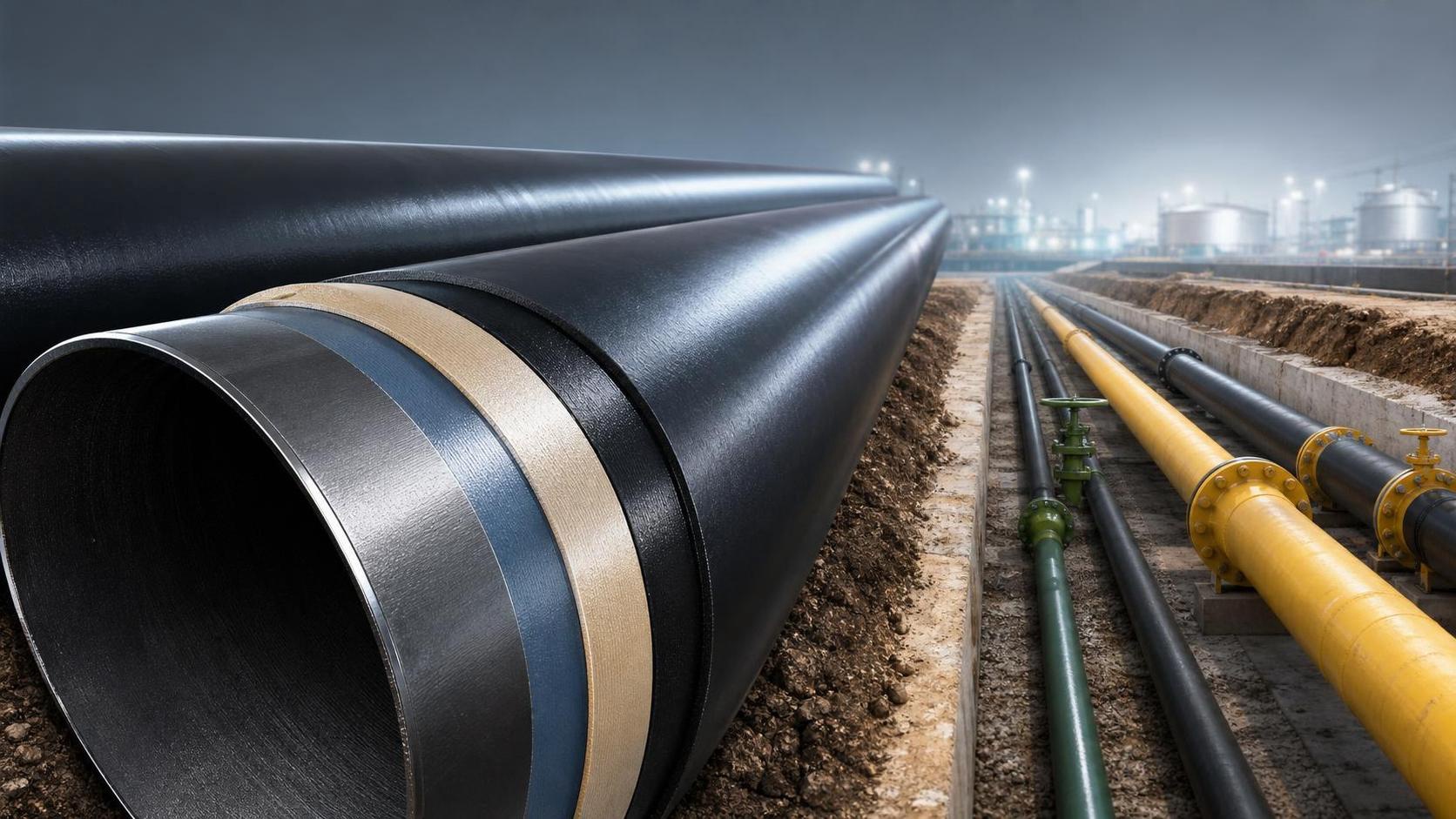
Why 3PE Pipe Selection Changes With the Medium
3PE pipe is often grouped into one category, yet field performance depends heavily on what moves inside the line.
Water, gas, and oil systems may all use steel pipe with three-layer polyethylene coating, but they do not stress the pipe in the same way.
In practical steel pipeline work, the useful question is not whether 3PE pipe can be used, but how the service condition changes coating priorities.
The base steel, external corrosion environment, pressure range, installation method, and maintenance access all shape the right decision.
That is why one 3PE pipe specification may perform well in buried water transmission, yet require different checks in gas or crude oil service.
In Real Projects, the Operating Context Matters More Than the Name of the Line
A 3PE pipe combines epoxy primer, adhesive layer, and polyethylene outer layer.
This structure mainly protects the outside surface of steel pipe against soil corrosion, moisture, and mechanical damage during handling and burial.
Even so, different media create different design logic.
Water lines usually focus on long-term corrosion resistance, water quality compatibility, and stable life-cycle cost.
Gas lines pay closer attention to leakage risk, pressure integrity, coating continuity, and joint treatment after welding.
Oil transmission often adds tougher demands from temperature variation, heavier loads, complex terrain, and chemical exposure linked to the product stream.
Because 3PE pipe belongs to the steel and structural materials chain, these differences should be read through both material behavior and site conditions.
Water Transmission Usually Favors Stability Over Extreme Load
In water projects, 3PE pipe is widely chosen for buried municipal lines, industrial water transfer, irrigation mains, and long-distance supply routes.
The main concern is usually external corrosion rather than aggressive internal media.
That changes the judgment point.
More attention goes to soil resistivity, groundwater presence, coating thickness consistency, and damage during transport or trench installation.
For many water systems, service life matters more than pushing the highest pressure class.
Another practical issue is maintenance access.
When lines are buried under roads or built-up utility corridors, repair cost rises quickly.
In that setting, a 3PE pipe with reliable coating adhesion and careful field joint wrapping becomes more valuable than a lower initial price.
Where potable water is involved, it also helps to separate external coating performance from internal lining requirements.
A common mistake is assuming the external 3PE pipe coating alone answers all water-contact concerns.
In reality, internal protection may need a separate lining choice based on water chemistry and hygiene standards.
Gas Pipelines Need Tighter Control of Continuity and Joint Integrity
Gas transmission uses 3PE pipe because buried steel lines need durable external corrosion protection over long distances.
However, gas service raises the consequence of failure.
That shifts attention from general coating durability to system integrity as a whole.
In actual gas applications, the coating must work well with cathodic protection, and the welded field joints cannot become weak points.
Holiday detection, peel strength, impact resistance, and backfill quality deserve closer review than many first-time users expect.
Gas lines also face stricter scrutiny at bends, fittings, crossings, and valve areas.
These locations tend to see handling stress, coating discontinuity, or uneven compaction after installation.
For this reason, 3PE pipe in gas service is rarely just a material purchase decision.
It is a construction quality decision as well.
Where pressure is higher, confirming coating performance under seasonal soil movement or settlement becomes even more important.
Oil Service Often Brings Harder Mechanical and Thermal Demands
Oil pipelines also rely on 3PE pipe for external corrosion resistance, especially in buried or cross-country steel line construction.
But oil service is usually less uniform than water service.
Product temperature may fluctuate.
The transported oil may contain water, sediments, or corrosive components.
Terrain may include remote sections, river crossings, and zones with higher mechanical load.
These conditions do not automatically rule out 3PE pipe, but they change what should be checked before specifying it.
Higher operating temperatures can affect coating performance limits, especially if the line is expected to run warm for long periods.
In those cases, the decision may involve comparing standard 3PE pipe with higher-temperature coating systems.
Mechanical protection also becomes more critical where pipe sections are pulled, bored, or installed through abrasive soil.
For oil pipelines, the most reliable selection process usually combines coating review with route-specific construction planning.
Different Media Change the Decision Priorities
A side-by-side comparison helps clarify why the same 3PE pipe cannot be judged by one standard alone.
What Usually Decides Whether a 3PE Pipe Is the Right Fit
A useful evaluation does not start from the coating name alone.
It starts from the actual line environment and the steel pipe duty.
- Check the installation method, especially open trench, directional drilling, road crossing, or rocky backfill.
- Confirm whether operating temperature stays within the practical range of the selected 3PE pipe system.
- Review soil chemistry, moisture, and stray current exposure instead of relying only on nominal coating thickness.
- Separate external corrosion protection from internal corrosion or hygiene requirements.
- Verify field joint coating procedure, inspection method, and repair standards before installation starts.
- Match steel grade, wall thickness, and pressure design with the coating system, rather than treating them as separate decisions.
These checks are especially important when comparing several 3PE pipe options that appear similar on paper.
Common Misjudgments That Create Trouble Later
One frequent error is copying a successful water pipeline specification into gas or oil service without rechecking temperature, pressure, and joint details.
Another is focusing on coating thickness alone.
A thicker outer layer does not automatically solve poor surface preparation, weak adhesion, or damage during handling.
There is also a cost-related misunderstanding.
Choosing a cheaper 3PE pipe without reviewing field repair frequency, service interruption risk, and inspection cost can raise the real project cost later.
In mixed terrain, treating all buried sections as identical is another weak assumption.
A flat urban trench, a river crossing, and a hot oil segment rarely ask the same thing from the coating.
A Practical Way to Narrow the Right 3PE Pipe Option
A workable next step is to map the line by service condition rather than by project name.
List the medium, operating temperature, design pressure, soil condition, installation method, and expected maintenance difficulty for each section.
Then compare those conditions against coating limits, steel pipe specifications, and field joint requirements.
For water service, confirm external protection life and any internal lining needs.
For gas service, put extra weight on continuity, testing, and cathodic protection coordination.
For oil service, review temperature exposure and route-specific mechanical risk before locking the final 3PE pipe specification.
That approach usually leads to a more durable pipeline choice, fewer field corrections, and a decision that fits the actual steel application instead of a generic label.
Can't find what you're looking for ?
Leave a Message we will call you back quickly!
Product Classification