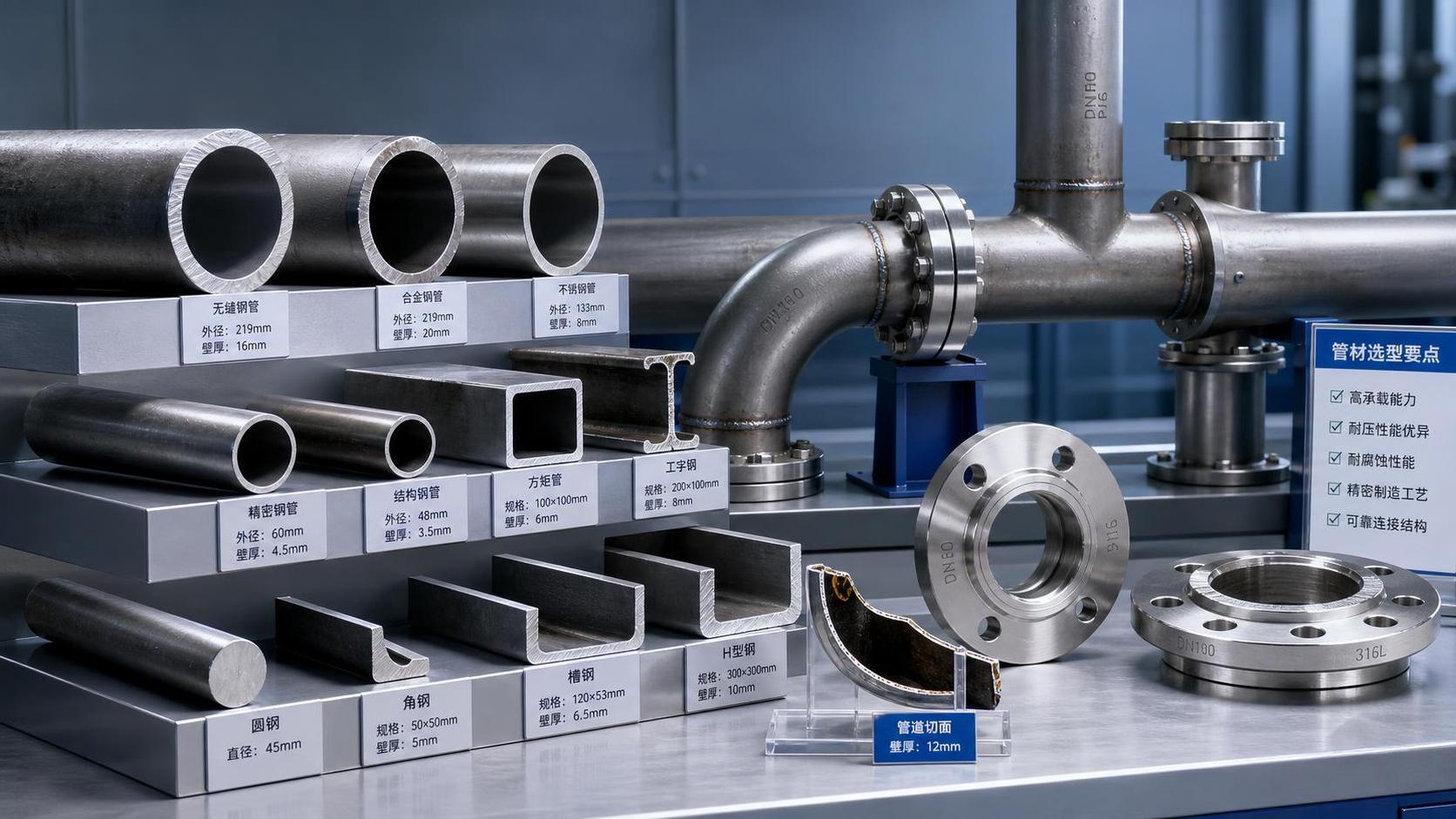
Start with the failure mode, not the catalog size
When load, internal pressure, and corrosion all matter, picking Industrial Steel Tubing by outside diameter alone is how bad decisions get baked in early. The tubing has to survive the real job: bending loads, pressure cycles, installation abuse, fluid chemistry, outdoor exposure, and the way the assembly is actually fabricated. Technical evaluators usually know this already, but the common trap is handling each factor separately and ending up with a tube that looks acceptable on paper while carrying unnecessary risk in service.
A better selection process starts with one question: what must this tube resist first? In some systems, collapse or burst pressure drives the decision. In others, the real problem is deflection, fatigue at supports, or wall loss from corrosion over time. Once that is clear, the rest of the screening becomes much faster and more defensible.
Define the service conditions before comparing grades
Before looking at material options, lock down the operating case. Not the ideal case. The one the tube will actually see.
- Maximum internal pressure, including startup spikes, pump surges, and upset conditions
- External loads: dead weight, vibration, supports, clamps, bending spans, and impact risk
- Operating temperature range, because strength and corrosion behavior can change with temperature
- Process media, cleaning chemicals, moisture, salt, condensation, or stagnant conditions
- Required life and maintenance philosophy: replaceable component or long-life installed system
If any of those are still vague, the evaluation is not ready for a final tubing call. The missing inputs matter more than one more round of supplier quotations.
Check whether load or pressure is really the controlling factor
A lot of teams assume pressure service automatically means pressure governs. That is not always true. Long unsupported runs, cantilevered connections, moving equipment, or heavy end fittings can make structural load the limiting case even when internal pressure looks serious.
For pressure-driven selections, the wall thickness question comes first. Thicker wall generally improves pressure capacity, but it also changes weight, bending behavior, fitting compatibility, and forming difficulty. For load-driven selections, section properties matter more than nominal tube size alone. Two tubing options with similar outside diameter can behave very differently once wall thickness changes.
A practical screening step is this: identify the case that gives the smallest safety margin. If pressure margin is comfortable but span deflection is high, do not keep optimizing pressure calculations while ignoring stiffness. If bending is fine but cyclic pressure is close to the allowable envelope, shift the review there.
Do not separate wall thickness from corrosion allowance
This is one of the most expensive mistakes in tubing selection. Teams pick a wall thickness for pressure or handling strength, then treat corrosion as a coating question only. In many services, expected wall loss over time has to be considered in the original thickness decision.
The key issue is not whether corrosion exists. It is what kind:
- Uniform corrosion may be manageable if you can account for gradual wall reduction.
- Pitting is more dangerous because average wall loss can look small while local failure risk rises quickly.
- Crevice corrosion often shows up around clamps, threaded areas, and deposits.
- Galvanic attack becomes a real issue when the tube material sits against a dissimilar metal in a wet environment.
If the environment suggests localized corrosion rather than even metal loss, adding wall alone may not solve the problem. That is usually the point where material grade, surface condition, joint design, and drainage details need to be reviewed together.
Match the steel grade to the environment, not just the mechanical target
Industrial Steel Tubing can look interchangeable in a specification list, but the grade choice changes more than strength. It affects weldability, toughness, forming behavior, and resistance to the chemicals or atmosphere the tube will face.
For evaluation purposes, keep the discussion grounded in service conditions:
Do not evaluate the grade in isolation from finishing and fabrication. A tube with a suitable alloy can still perform poorly if the weld seam quality, coating integrity, or post-fabrication treatment is not aligned with the service.
Review the manufacturing route, because it affects consistency
Technical buyers often focus on grade and dimensions while skipping the production route. That is risky. Seamless and welded tubing are not automatically better or worse across all uses, but the manufacturing route changes dimensional tolerance, weld seam considerations, surface finish, and inspection priorities.
What matters in practice is whether the route fits the application. If the design includes severe cyclic loading, aggressive media, or critical fittings at specific locations, the seam area and inspection method deserve direct attention. If tight dimensional consistency is important for automated fabrication or sealing interfaces, tolerance control may matter more than a broad material label.
Check the joining method before finalizing the tube
Selection mistakes often show up at the joint. The tube may be adequate, but the way it is cut, bent, welded, threaded, flared, or mechanically fitted turns it into a weak point.
Three quick checks help here:
- Make sure wall thickness is compatible with the intended joining process. Some thin-wall tubes do not tolerate the same fabrication steps as heavier sections.
- Review whether welding, threading, or cutting will remove or damage corrosion protection at the most exposed areas.
- Confirm whether post-join cleaning, passivation, coating repair, or pressure testing is part of the actual work scope.
That last point gets missed a lot. A material that performs well in mill condition may not stay that way after shop fabrication if the surface treatment is disrupted and never restored.
Use standards as a screening tool, not as a shortcut
Standards and specifications matter because they define what the tubing is supposed to be: chemistry, dimensions, tolerances, mechanical properties, test requirements, and sometimes manufacturing method. But a standards callout alone does not prove the tube is right for the application.
For a technical evaluation, the useful check is more specific: which document controls which risk? One document may govern tube dimensions and material. Another may control pressure system design. Another may define welding qualifications, inspection, or end-use compliance. When reviewing a supplier offer or internal specification, check the exact grade designation, size tolerance, wall tolerance, and test documentation requested. “Meets standard” is not enough if the project depends on a particular condition, finish, or inspection level.
Watch for the hidden cost drivers
The lowest material cost can still produce the highest installed cost. In tubing work, that usually happens through one of four paths: extra supports, difficult bending, coating repair, or premature replacement.
If you are comparing options that all appear technically acceptable, ask which one causes the least downstream friction. A slightly thicker wall might reduce damage during handling. A different grade may simplify welding. Better corrosion resistance may eliminate recurring shutdown work. Those are real selection factors, especially when maintenance access is poor or the tubing is part of a larger assembly that is expensive to disturb.
A practical checklist for final selection
Before approving Industrial Steel Tubing, run through this short decision list:
- Have the maximum pressure, temperature, and load cases been defined using actual operating conditions?
- Is the controlling failure mode clear: burst, collapse, deflection, fatigue, or corrosion-related wall loss?
- Does the wall thickness still work after accounting for expected corrosion exposure and fabrication effects?
- Is the selected grade appropriate for both mechanical duty and the chemical or atmospheric environment?
- Have supports, spans, fittings, and joints been reviewed as part of the tubing decision rather than after it?
- Does the specification call for the exact material condition, dimensions, tolerances, and test documents the project needs?
- Will the chosen option remain practical to fabricate, inspect, and maintain in the field?
If any answer is still vague, that is where the next review cycle should go. Not back to a generic price comparison.
Make the decision in the same order the risks appear
A reliable tubing selection usually follows a simple order: define service conditions, identify the controlling failure mode, size for pressure and load, then check corrosion exposure, fabrication method, and required documentation. That sequence keeps the discussion anchored in risk instead of preference.
For technical evaluators, that is the real goal. Not finding a tube that merely fits the drawing, but choosing one that still makes sense after pressure fluctuations, support loads, shop work, and environmental exposure are all brought into the same decision.
Can't find what you're looking for ?
Leave a Message we will call you back quickly!
Product Classification